
The finishing details · Rock & Co
Kitchen sink options.
A considered choice.
Compare sink materials, fitting styles and bowl layouts to find the right partner for your quartz, granite or porcelain worktop.
Choose your sink and tap before templating, so we can plan the cut-out, support and finishing details together.
Choose your material
Made for the way you use your kitchen.
The right material balances appearance, everyday care and the demands of your household. Performance and care instructions vary by product: check the specification of your chosen sink.
Stainless steel
A versatile choice for contemporary and classic kitchens. Stainless steel is easy to clean, but surface scratches and water marks can develop with use. Brushed or textured finishes can make marks less conspicuous.
Granite or quartz composite
Mineral particles combined with a binder give composite sinks a stone-like appearance in a range of colours. Heat, scratch and stain resistance depend on the formulation. Follow the maker’s cleaning instructions and remove limescale regularly.
Ceramic and fireclay
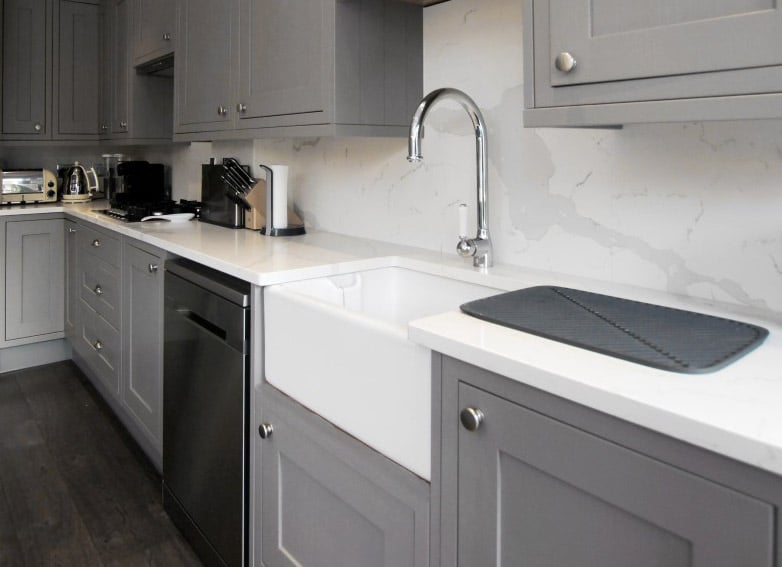
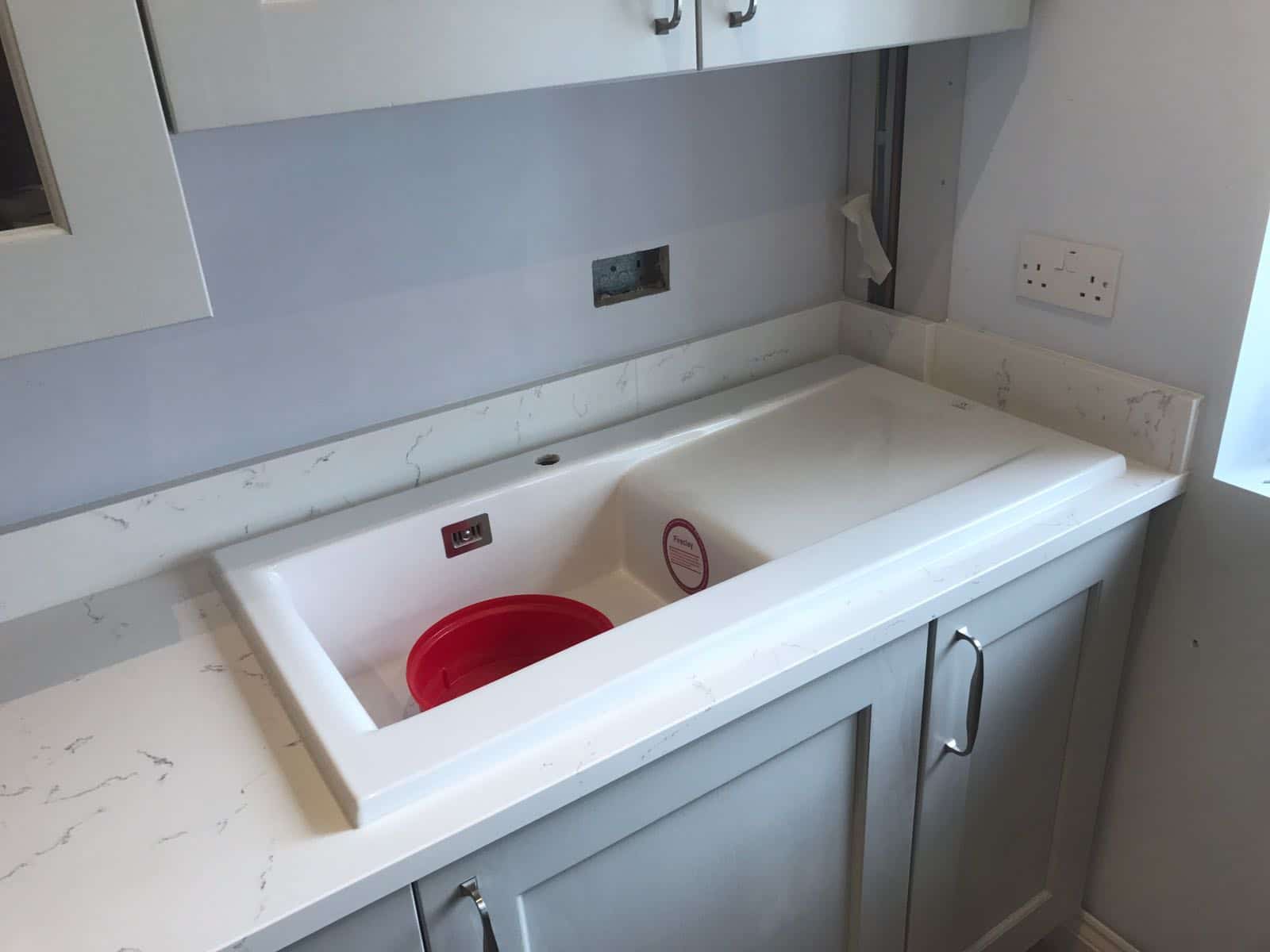
A crisp, glazed finish that suits traditional kitchens and apron-front designs. These sinks can be heavy and need suitable cabinet support. Avoid dropping heavy cookware: hard impacts can damage the glaze or sink.
Resin and natural stone
Resin sinks offer a range of finishes, with durability depending on the product. Bespoke natural stone sinks offer individual character, but stone type determines sealing and care needs. Confirm suitability, support and maintenance before ordering.
The meeting of sink and stone
Find the right fitting style.
Inset or top-mount
The sink sits in a cut-out with its rim resting on top of the worktop. The rim stays visible and may include an integrated drainer. An inset sink is a different installation from an undermount sink; use the fitting method approved for the model.
Undermount
The bowl fixes beneath the worktop, leaving the finished cut-out edge visible and allowing crumbs to be wiped into the bowl. It is a popular option with stone worktops. The sink needs appropriate fixing and support; standard laminate is generally unsuitable unless an approved specialist system is used.
Flush-mount
A compatible sink sits in a precisely machined recess with its rim level with the worktop. This requires careful fabrication and an approved combination of sink and surface. Ask us to check feasibility before buying.
Belfast, Butler or apron-front
The exposed front creates a distinctive feature. These names describe related designs rather than one universal fitting method. Cabinet dimensions, sink weight, support and the worktop overhang must be planned for the specific model.
For product-specific details, see BLANCO’s sink installation guide and your chosen model’s fitting instructions.
Everyday practicality
One bowl, or room for more?
| Layout | Useful for | Check before choosing |
|---|---|---|
| Single bowl | Washing larger pans and oven trays. | Internal bowl dimensions and space for a drainer. |
| One-and-a-half bowls | A main bowl with a smaller space for rinsing or food preparation. | Whether the smaller bowl suits your routine and fits the cabinet. |
| Double bowl | Separate washing and rinsing areas. | Each bowl’s usable size and the overall cabinet width. |
| Round or compact bowl | A smaller kitchen, utility room or secondary preparation area. | Whether your largest cookware fits comfortably. |
Choose an integrated drainer, a removable drying rack or suitable worktop drainer grooves. Grooves guide water towards the bowl but do not replace drying and routine cleaning.
Before we template
Get the details right from the start.
- Confirm the exact sink model, installation type and manufacturer’s cut-out information.
- Check cabinet width, bowl depth and space for waste fittings and plumbing.
- Agree the tap position, number of holes and clearance around windows or splashbacks.
- Plan sink support, the exposed edge finish and any drainer grooves.
- Confirm who supplies the sink, installs it and completes the plumbing connections.
- Ask our team when the sink and tap need to be available for templating.
Explore our quartz worktops, granite worktops and porcelain worktops, or see how our worktop service works. We can help coordinate your sink choice with the surface and kitchen layout.
Your questions
Kitchen sink options, explained.
Can I use an undermount sink with quartz worktops?
Often, yes. The sink model, cabinet support and cut-out design must suit the worktop. Confirm the specification with our team before ordering or templating.
Is a composite sink the same material as a quartz worktop?
No. A composite sink and an engineered stone worktop can use different minerals, binders and manufacturing processes. Follow each product’s own care instructions.
Which kitchen sink is easiest to maintain?
There is no single answer for every household. Compare the maker’s care guidance, your water hardness and the finish you prefer. Regular cleaning and drying help reduce water marks and limescale.
Can I replace my sink without replacing the worktop?
Sometimes, but the existing cut-out, fixing access and cabinet dimensions limit your choices. Ask us to assess the installation before buying a replacement; a different model may require worktop alterations.
Should I choose my sink before templating?
Yes. Agree the exact sink and tap models in advance so the cut-out, tap holes, supports and clearances can be checked. Our team will confirm what needs to be on site.